Lightweight
STLGRU
A spatio-temporal lightweight gated recurrent architecture. The larger of the two models in this workstream — 4.1× the parameter count of LiteSTGNN, and the reference point against which the smaller model's accuracy is read.
Workstream 3 Individual contribution
Zoleka Fuyana — how much forecasting accuracy survives a hard cut to the parameter budget, and where extra capacity stops paying for itself.
Accuracy reported in the STGNN literature is usually bought with parameters, and the parameter budget is rarely treated as a variable of interest in its own right. Benchmarks reward the lowest error and report model size, if at all, as a footnote.
This workstream inverts the question. Rather than asking how much accuracy a larger model can reach, it asks how much accuracy survives when the parameter budget is cut hard, and at what point additional capacity stops earning its cost. Two lightweight architectures — STLGRU and LiteSTGNN — are evaluated against the same AGCRN and CLCRN baselines, on the same 32-station network and the same 48-hour horizon as the other two workstreams.
The question is operational as much as scientific. A model cheap enough to retrain frequently, or to run where compute is scarce, can be worth more in practice than a marginally more accurate model that is neither — and South African weather services are exactly the kind of setting where that trade-off is real rather than hypothetical.
Lightweight
A spatio-temporal lightweight gated recurrent architecture. The larger of the two models in this workstream — 4.1× the parameter count of LiteSTGNN, and the reference point against which the smaller model's accuracy is read.
Lightweight
The smaller of the two, and the more aggressive reduction in capacity. Its performance relative to STLGRU is what makes the diminishing-returns result measurable.
This workstream runs on the project's shared foundation: the same 32 South African Weather Service stations, the same hourly record from 2016 to 2025, the same chronological 60 / 20 / 20 split, the same inverse-distance imputation, the same four forecast targets and the same two baselines. Error is reported at 6, 12, 24 and 48 hours. See the shared experimental setup for the full specification.
Evaluation pairs standard forecasting error with the cost side of the trade-off — trainable parameter count and inference cost — so that accuracy and capacity can be read against one another rather than separately.
Result 1 · Capacity gives sharply diminishing returns
STLGRU is 4.1× the size of LiteSTGNN and improves MAE by only 0.7–5.7%. A fourfold increase in parameters buys a few percent of accuracy — which is the central quantitative claim of this workstream and a direct answer to the research question.
Result 2 · Competitive, but variable-dependent
Lightweight performance was competitive with the established baselines, but which model wins depends on which variable is being forecast. There is no single ordering that holds across temperature, pressure, humidity and wind speed — the same variable-dependence the other two workstreams report.
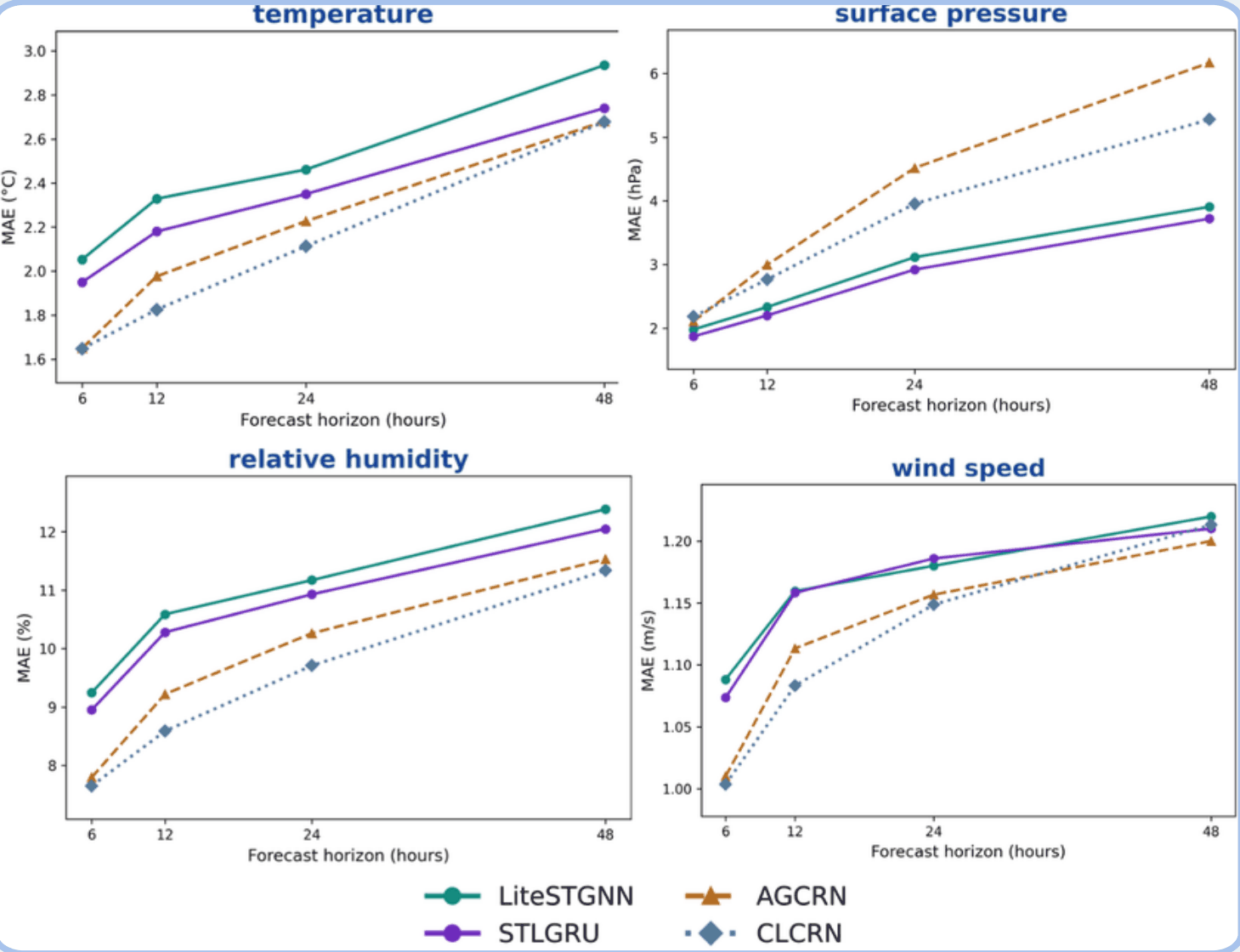
This workstream's result is the clearest statement of a pattern that appears across the whole project from three independent directions.
Approaching from the opposite end, the continuous-time workstream found the most accurate of its four models was also among the cheapest — 138,096 parameters against 1,663,104 for the weakest — and that CLCRN, the smallest of the four, separated from the far larger STGODE on every variable. Parameter count and inference speed did not even track one another there, so no ranking of those four was bought with scale.
Meanwhile the diffusion workstream found that what distinguished its two models was not capacity but conditioning: giving the generative step a well-structured representation and three cheap covariates was worth more than any amount of additional generative machinery.
Taken together: on this dataset, at this network size, model size and model accuracy are close to unrelated. What a model is given to work with — the graph, the covariates, the conditioning — matters considerably more than how large it is.